

Data collected by employee monitoring tools is typically perceived as a quantitative measure of an employee's efforts for spreadsheets and quarterly reports. X completed tasks, Y missed deadlines, and Z% productivity on average. However, monitoring data can be valuable material for providing constructive, actionable feedback. Want to know how? We have prepared some practical tips.
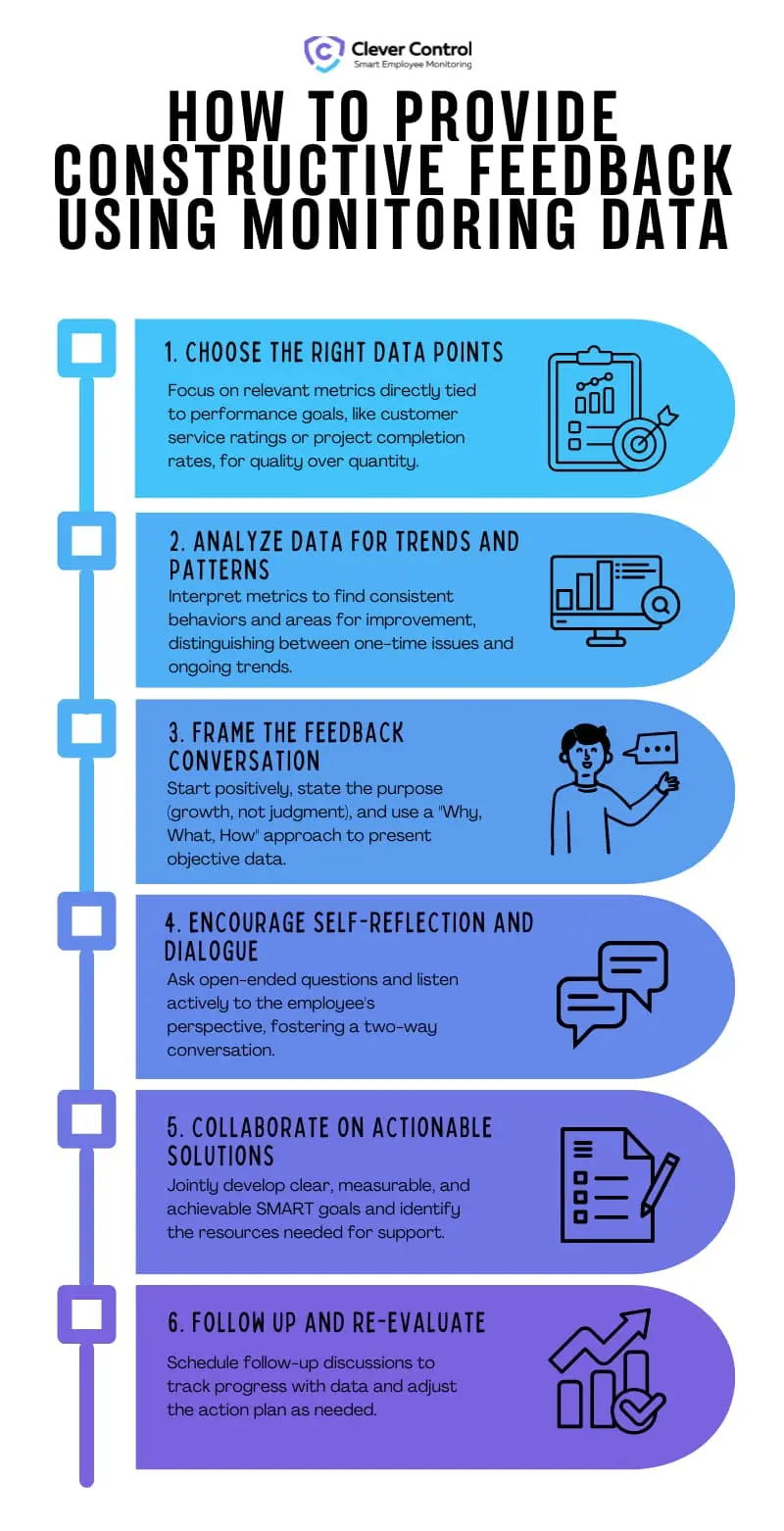
Consejo 1. Elija los puntos de datos adecuados
Consejo 2. Analice los datos en busca de tendencias y patrones
A spreadsheet with metrics alone does not bring much benefit. What does is its careful interpretation and discovery of trends and patterns. Has this metric always been low, or is it a one-off dip? Does this employee continuously struggle with a particular type of task? Does their focus always fluctuate at a certain time of the day? When you notice these patterns, you will be able to distinguish between one-time incidents and ongoing problems. Remember to consider the context too that may have influenced the employees' productivity, for example, an increased demand or technical problems.
Consejo 3. Enmarque la conversación
Approaching a feedback conversation with data requires a thoughtful touch. Always start with a positive. Acknowledge areas where the data shows strong performance or improvement. This sets a collaborative tone. Then, clearly state the purpose of the discussion: it's about growth and development, not judgment.
Un feedback constructivo significa ser objetivo y centrarse en el comportamiento más que en la personalidad. En lugar de decir "Siempre te saltas los plazos", prueba con "Los informes muestran que las tareas se han retrasado sistemáticamente este trimestre".
Considere un enfoque de "por qué, qué, cómo":
- ¿Por qué son importantes estos datos? (Relaciónelos con los objetivos del equipo, el impacto en el cliente, etc.)
- ¿Qué revelan concretamente los datos? (Presente las métricas y las tendencias observadas.)
- ¿Cómo podemos mejorar o aprovechar esta información de cara al futuro? (Esto allana el camino para la colaboración en la resolución de problemas).
Consejo 4. Fomentar la autorreflexión y el diálogo
Constructive feedback is a two-way street. When you have given your evaluation, give the employee a word to explain their vision of the situation. You may prompt them by asking open questions, such as "What are your thoughts on your results?" or "What do you think might have contributed to that dip in performance?" They will encourage the employee to reflect on their work and share problems they may be experiencing. Often, they'll have valuable context you might not be aware of, or even suggest solutions themselves. Listen actively and take notes of their insights.
Consejo 5: Colaborar en soluciones prácticas
El feedback constructivo es sólo el primer paso en el camino de la mejora. El siguiente es elaborar un plan de acción. Puedes utilizar un sistema de objetivos SMART (Specific, Measurable, Achievable, Relevant, Time-bound) o cualquier otro sistema, pero los objetivos que establezcas deben ser medibles, claros y alcanzables. "Mejora tu productividad" suena vago y plantea preguntas como "¿Qué se considera una mejora?", "¿Qué hago para mejorar?", "¿Cuándo se espera que muestre los resultados?", etc. Pero si usted y el empleado se ponen de acuerdo en "Me propondré reducir mi tiempo medio de finalización de tareas en un 15% durante el próximo mes utilizando la nueva herramienta de gestión de proyectos", el empleado sabrá exactamente a qué debe aspirar. Identifique los recursos, la formación o el apoyo que pueda necesitar de usted o de la organización para alcanzar estos objetivos. Con este enfoque colaborativo, el empleado le verá como un socio que le apoya, en lugar de como un supervisor estricto, lo que incluso puede subirle la moral.
Consejo 6. Seguimiento y reevaluación
Feedback is an ongoing process, not a one-time event. Use the employee monitoring tool to track the person's progress and, after some time, schedule follow-up discussions to check in on progress and re-examine the monitoring data. Seeing improvements is an incredible motivation for employees! But if the progress is minimal or too slow, it is a sign to adjust and enhance the action plan.
Crear una cultura de crecimiento
Building constructive feedback based on monitoring data not only enriches individual performance reviews with objective information and makes the manager's work easier. It also helps create a transparent and strong growth-oriented culture. Feedback grounded in objective information makes employees take ownership of their work and development. It moves away from subjective critiques and towards a shared understanding of performance and potential.