


Employee monitoring software is a system that can track and analyse employees' activity on their computers. It has been on the rise since the early 2000s due to the development of computer technologies, and the 2020's Covid-19 pandemic has sent its popularity spiralling up. According to the recent Instant Office study, 78% of today's employers track their staff using various tools.
Usually, employee monitoring software consists of the agent that employees install on their devices and the monitoring dashboard that allows managers to receive logs and reports.
Employee monitoring software provides visibility into configured work-related activity. From active time to visited websites, it collects configured work-related activity data on authorized company devices during working hours. More advanced employee monitoring software goes far beyond simply collecting the data. It provides ready-to-go reports on each employee's productivity and payroll calculations, and basically saves the manager's time.
The most overt purpose of this kind of software is to monitor employees' productivity. How much time do they spend on the project, and how much - on funny cat videos on Youtube? Are they involved in the work process or take coffee breaks every 10 minutes? Do they google work-related information or cheap tickets to Las Vegas for the weekend? Employee monitoring apps are designed to answer exactly these kinds of questions.
Besides finding out slackers, employee monitoring software serves several less obvious but no less critical purposes. To begin with, it can help to reveal struggling employees. Whether they are sweating over the overwhelming workload or tasks they have not enough experience with as young specialists, they may hesitate to tell the manager about the difficulties. Revealing these issues and carefully working towards eliminating them will do more than boost productivity - it will improve the climate in the office and your image as a manager.
Another not-so-evident reason to try an employee monitoring software is controlling company resources. Did your expenses on printer paper grow recently? Are you wasting money on the software your employees do not use? Find it out with the help of the reports. They will show how often employees work in a particular program or if they use office printers for personal needs.
The top-notch employee monitoring software is equipped with data protection modules. They prevent access, copying or sending confidential information and warn the administrator if something suspicious pops up. Having this all-knowing guard at your hand, you don't need to worry about data leakage or unauthorized access to corporate data.
These are only a few problems that employee monitoring tools can solve. Let's dive deeper into the topic and learn about top solutions in this field.
Types of Employee Monitoring Software
Employee monitoring software falls into three types: time tracking, activity monitoring and data loss prevention (or DLP).
Time tracking apps are essential if you look to automate routine processes such as attendance, time tracking and payroll calculations. They record login and logout time, periods of the employee's inactivity and time spent on each task. You can estimate how much time employees spend on a project and who and when worked on a specific assignment. Accurate tracking data is also vital for billing customers if you work on a contract or an hourly pay basis. The best part is that reports are generated in real-time automatically, eliminating the risk of cheating or human error. Time trackers have other benefits: they facilitate productivity improvements, motivate employees and show you where the money is spent.
The range of application of these reports is immense. They provide valuable insights on the productivity and involvement levels, help to discover ineffective work patterns and underperforming employees, save company recourses and more. If implemented carefully and ethically, activity tracking software can become a reliable partner in growing your business.
Data loss prevention (DLP) is the most advanced type of employee monitoring software. It works by inspecting data in use, in motion, and at rest — in emails, messengers, on employee devices, or on company servers — and blocking anything that looks like a policy violation before it can leave the organization.
To do this, DLP tools combine several techniques: exact data and file matching against a known database, rule-based scanning for patterns like card or ID numbers, and, for violations that don't fit a predefined category, more advanced methods like machine learning and behavioral analysis.
Companies use DLP systems to prevent data breaches, exfiltration, loss, leakage or destruction of sensitive information, and to ensure the company complies with relevant regulations and protects Personally Identifiable Information (PII). For a closer look at how modern DLP tools compare, see our guide to the best DLP software.
In this article, we will mostly focus on activity tracking software.
Features of Employee Monitoring Software
Despite the large selection of activity monitoring software on the market, many features are typical for most of them. Let's have a look at the functionality that you can expect from a decent employee monitoring app:
- Company-owned device activity monitoring
- Project management system integration
- Time tracking software
Whatever devices and locations your team works from, the key is to keep monitoring proportionate and clearly communicated. Stick to company-owned equipment where possible, get consent when personal devices are involved, and collect only the data you actually need to manage performance and protect company assets. For a closer look at what's legally required in your region, see our guides on GDPR requirements for employee monitoring and employee monitoring laws by state.
Benefits of Monitoring Employee Social Media
Social media is one of the biggest sources of workplace distraction — notification-driven feeds are built to pull attention away from whatever task is at hand, and it doesn't take much for a quick check-in to turn into a 20-minute scroll. For businesses, keeping an eye on employees' social media activity, and their broader online presence, is a practical way to protect both productivity and reputation.
Here are the main benefits of monitoring employees' social media:
Reducing Cyberbullying
With cyberbullying on the rise these days, it's crucial for employers to monitor their employees' online behavior, especially those who work online. This way, they can prevent employees from engaging in cyberbullying or becoming victims of it themselves.
Boosting Performance
Social media monitoring is built on IM monitoring, and similar methods. By remotely tracking workers' online activity, employers can track their performance and spot potential areas for improvement. Plus, they can use this same data to better assess employees' overall engagement with company goals.
Maintaining Credibility
Employees are the face of the company. That's why they're the ones representing it when they show up in the social sphere. Organizations should therefore make sure these employees build a positive reputation elsewhere too, and don't knowingly or unknowingly tarnish the brand.
Strengthening Security
At the end of the day, businesses don't want to be threatened from within. Employers can prevent these threats by carefully monitoring their employees' online behavior. They should therefore keep a constant eye on employees' social media accounts so that, even in the event of a breach, they're alerted in time.
Pros and Cons of Employee Monitoring
With the prevailing issue of cyberattacks and the increasing need for workplace accountability, organisations weigh in on the advantages that employee monitoring tools accrue. To that end, here's a profound rundown of the pros and cons of employee monitoring.
Here are the main pros and cons of employee monitoring:
Pros
Improved Productivity
Employee monitoring solutions give organizations real-time insight into employees' work habits. These insights are, in effect, quantifiable indicators that can be used to measure productivity. This lets employers build dedicated feedback channels and measure both individual and team performance.
Streamlined Workflow
Many internal business processes often stall because of last-minute needs. Sometimes, the resources to complete them may be insufficient. A large part of this relates to how employees' day-to-day workflow is affected. If the employees in question were carefully monitored, much of this could be prevented, since they'd be able to stay on top of their tasks and finish them on time.
Cost Efficiency
The old adage saying, "Prevention is better than Cure," holds true at all times. When it comes to employee monitoring, the cost of losing a business to a cyber threat is at least tenfold that of preventing one from happening. Using lawful employee monitoring tools can help organizations reduce security risks and improve time and resource utilization. Plus, these solutions keep tabs on efficient time and resource utilisation, thus saving an organisation a great deal in the long run.
Cons
Trust Factor
Sometimes organizations lean toward strict measures meant to hold employees accountable for their actions. However, these measures are often met with distrust from employees, especially when privacy concerns are involved. As a result, some employees may refuse or push back against following written policies and procedures. This, in turn, slows down productivity, causes delays, and negatively affects the organization's reputation.
Legal Factor
In some countries and their respective states, strict laws and regulations govern employee monitoring. Because of this, an organization can run into trouble with any unlawful monitoring. This means organizations must keep up with the latest rules and regulations of the country they operate in, and consult legal counsel when needed.
Ethics of Employee Monitoring
In the pre-pandemic scene, employee monitoring was largely seen as an intrusive and predominantly unethical practice. But that changed quickly in the new normal as the practice became a necessary and innocuous safety precaution to protect the assets of an organisation. However, as we emerge from this distressing time, the questions remain over how far a business should go in its quest for complete surveillance of its employees and what moral boundaries must be adhered to in the process. Here's a rundown of the same:
Practicing Consensual Monitoring
Covert employee monitoring might seem like a logical way to avoid disrupting the work environment, but it can also come across as an extreme invasion of employee privacy. So, if a company wants to keep an eye on its employees, it needs to show that it cares about their well-being through closer oversight of what and how they do things. Employees must be aware that their computers, phones, and network are being monitored using an employee monitoring tool.
Evaluating the Motivation Behind Monitoring
Before rolling out employee monitoring, a company should evaluate its reasons and motivations. The emphasis should be on tangible benefits, not intrusiveness. Most often, monitoring is carried out to catch employees who are deliberately wasting time at work or engaging in copyright violations or viewing inappropriate material.
Lately, though, the motivations behind monitoring go beyond these boundaries and extend to things like cyberbullying, identity theft, and even insider trading. So before committing to an employee monitoring solution, businesses need to outline why, how, and what they want to monitor. This includes evaluating the boundaries of data collection methods, the possible consequences for employees, and the acceptable use of the data.
For example, they wouldn't want to invest in scanning IM chats on social media if that's not relevant to their industry. Ultimately, such motivations should be explained to employees to promote operational transparency.
Considering Privacy Protection
When rolling out employee monitoring, companies need to keep in mind how important it is to maintain a private and secure work environment for their employees. For example, monitoring outside working hours can be a source of stress for some employees and may push them to leave their jobs. Employees should also be able to work without worrying that their privacy is being violated or that management is accessing their personal data without authorization.
Choosing the Ideal Tool
All the considerations above point to the ideal tool for implementation. Care must be taken to ensure the solution aligns with the organization's goals and meets its security standards. This is where advice from legal counsel can be valuable, to ensure compliance with state-specific laws and regulations.
Employee Monitoring and the Law
Every country or state has its own laws governing employee monitoring. Some states take a strict view of employee monitoring, while others take a more liberal approach. Take this: Indian employment and labor laws do allow for the concept of surveillance and monitoring of employees in the workplace. Yes, Section 21 emphasizes the right to privacy, but the legality of employee monitoring practices isn't explicitly clarified. Here's an overview:
Contrarily, some of the U.S. laws are more concrete. For example, the Electronic Communications Privacy Act of 1986 enables workplace monitoring, considering that businesses have a legitimate reason to do so. Further, every US state has its own share of regulations regarding phone call recording. Then there's the Video Privacy Protection Act and additional regulations around the disclosure of "videotapes" to prevent wrongful disclosure.
As for the United Kingdom, the Regulation of Investigatory Powers Act 2000 (RIPA) is often cited for monitoring with consent. The General Data Protection Regulation (GDPR) also has a say, governing access to personal data and how it's processed. In Australia, monitoring is allowed, though in a more limited form, under the Privacy Act 1988, the Workplace Surveillance Act 2005, the Surveillance Devices Act 1999, and others.
All in all, every country and the corresponding states have their own unique laws governing the use of employee surveillance. The overarching notion, though, is that an employer can monitor their employee in the workplace, as long as it's within the confines of their respective state laws. For a state-by-state breakdown of what's allowed in the US, see our guide to US monitoring laws.
GDPR and Employee Monitoring
The General Data Protection Regulation (GDPR) explicitly focuses on data privacy policies for people residing in the European Union (EU). Article 6 of the regulation stresses the lawfulness of processing and, in the same vein, provides a direction for employee monitoring best practices across Europe. For instance, Article 6 outlines that data processing is "lawful":
- If the employee has given consent to the collection and processing of their data for a specific purpose.
- If the purpose of the data processing is to ensure compliance with legal requirements.
- If the data processing is carried out in the public interest.
- If the data processing is carried out in the employee's interest.
Likewise, GDPR allows EU member states to follow points 2 and 3 based on Union and member state law. Overall, GDPR serves as a source of confidence for employers across the European Union regarding their employee monitoring policies and procedures.
In fact, it provides them with concrete directions to pursue when there's uncertainty about whether the data collected is being put to use for the purpose it was originally intended for. Such uncertainty can arise if there's a risk that the personal data gathered is being misused.
GDPR therefore essentially helps employers maintain integrity, confidentiality, accountability, accuracy, fairness, and lawfulness when processing data. For the full breakdown of requirements, see our GDPR requirements for employee monitoring guide.
Employee Monitoring Trends in 2026
Over the past few years, employee monitoring has evolved from simple productivity tracking into comprehensive and sophisticated management and security systems. Advances in monitoring technology are accompanied by a growing emphasis on ethical implementation and shifting privacy regulations. In 2026, we're seeing a clear trajectory toward smarter, more integrated, and more transparent systems.
Employee Monitoring as the New Norm
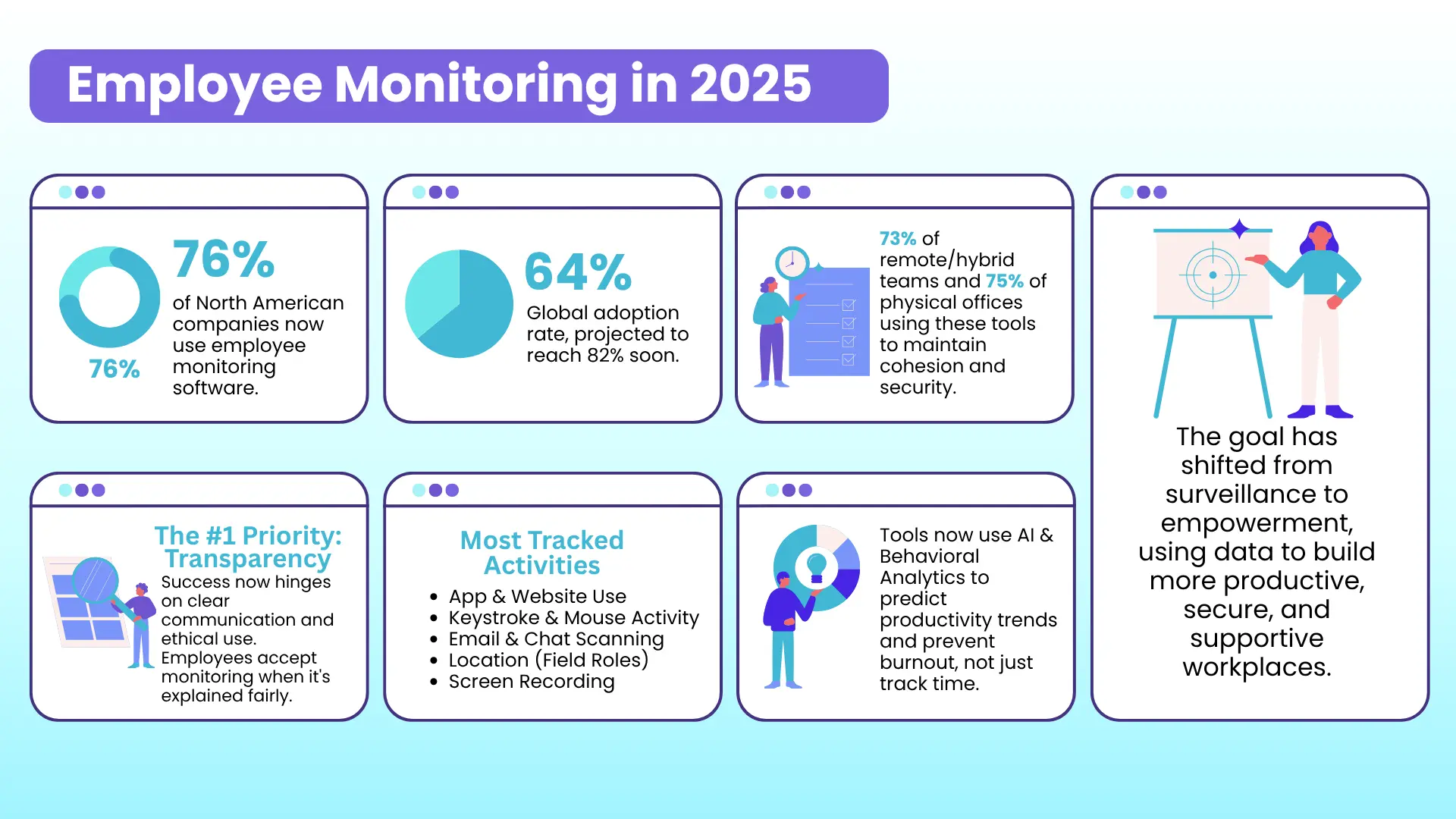
Employee monitoring is no longer a niche practice — it's a mainstream business tool. Current data shows that around 76% of companies in North America now use some form of employee monitoring, a significant jump from 42% in 2020. Globally, the adoption rate is around 64%, and it's projected to reach 82% in the near future. Monitoring is now common across all work environments, with more than 73% of remote/hybrid teams and 75% of physical offices using these tools to maintain cohesion and security.
Real-Time Insights and the Rise of AI
AI and machine learning are being actively integrated into employee monitoring. Modern systems go beyond passive data collection to provide predictive insights into productivity patterns, potential insider threats, and compliance risks.
- Real-time activity tracking is a cornerstone, with 86% of tools now giving managers a live view of app usage, task switching, and idle time.
- Behavioral analytics uses AI to detect patterns in employee activity, identifying both performance trends and potential risks before they escalate.
- Automated features like screenshot capture (78%), chat monitoring (40%), and remote access (28%) are now standard, but attention has shifted to how AI puts this data into context and turns raw information into actionable insights — for example, by scanning messages for flagged content.
Balancing Insights with Ethics and Privacy
As the technology grows more powerful, the conversation has rightly shifted to its ethical use. Employee awareness of privacy protection is at an all-time high, which is pushing companies to increase transparency.
- Transparent communication about what is being monitored and why is now essential to maintaining trust. Most employees accept a reasonable level of monitoring as long as it's clearly explained and fairly implemented.
- Mental health impacts are being taken seriously, with studies noting that excessive surveillance can lead to employee stress. This underscores the industry's shift toward balanced approaches that focus on outcomes and team-level analytics rather than constant individual oversight.
- Ethical use of monitoring tools is now a key differentiator for top-tier employers, involving clear policies, respecting boundaries, and ensuring monitoring serves to support — not merely control — the workforce.
Most Monitored Activities in 2026
The scope of monitoring has settled around key digital activities:
- App and software usage
- Web browsing and URL monitoring
- Email and messaging scanning, often with AI to flag specific content
- Location tracking via GPS for field-based roles
- Screen recording and periodic snapshots for activity verification
These trends reflect a maturing industry that is learning to balance detailed operational insights with growing employee expectations for privacy and ethical transparency. Employers are increasingly adopting sophisticated, AI-powered solutions not merely for oversight, but to foster a more productive, secure, and supportive work environment.
FAQs
How are employers monitoring their employees?
Employers are mostly monitoring the general work performance or attendance of the employees through employee monitoring software. These days, employers are increasingly turning to these solutions as a resource to motivate and reward their employees, increase productivity, and drive decision-making.
What can employee monitoring software do?
Employee monitoring software has evolved quite a lot and is now used for much more than just tracking work hours. These tools can help businesses track employees on social media and the web, provide performance assessment reports, detect risks and frauds, etc., — all while enabling remote monitoring.
Does employee monitoring increase productivity?
By providing insight into the work habits and productivity of the employees, employee monitoring software helps businesses figure out what needs to be done to increase productivity. The right employee monitoring software can help identify and quantify factors influencing an employee's productivity, like work environment, workload, engagement levels, etc.
How do employees feel about being monitored?
That's a subjective question. While some employees may not mind being monitored, others may feel fenced in. This depends on several factors, like their level of trust in their employer and management, the industry they work in, etc. This is why businesses must take necessary precautions (employee consent) and ensure that they're not violating the privacy of their employees while achieving their goals.
How much monitoring of employee activities is appropriate at work?
There is no universal agreement on when and how many activities should be monitored. The way it is managed depends on the company culture, the industry of the business, and other factors. However, most industries that involve heavy data processing and analysis, such as banking, financial services, and health care, tend to focus quite highly on holistic employee monitoring.
Is employee monitoring legal?
In general, yes. However, public sector and social service organisations often have certain restrictions on the use of employee monitoring software. Besides, states can have different laws and regulations that govern the employee of, let's say, video surveillance, data collection, etc. Therefore, employers must put in place adequate safeguards to protect against potential data breaches and misuse of information by adhering to their state's privacy laws.
Do employers have to notify employees of monitoring?
The best practice is to notify employees as soon as the employee monitoring solution has been (or is to be) deployed. This way, employees will be aware of what their employers are monitoring and in what capacity. It also allows them to voice any concerns they might have.
Is it legal to monitor employees without their knowledge?
The legality of this is dependent on the state's privacy laws. Some states do allow this, provided specific requirements are met. Even then, the employees must consent to their employers monitoring their activities, and the employer must state in their privacy policies what will be monitored, how it will be used, etc., to prevent any data misuse.
Can employee monitoring be done ethically?
The ethical use of employee monitoring software depends on the relevant digital assets being treated as private and confidential. Employers must follow the applicable laws in case of data breach and legal ramifications. It is also essential that employers clearly state what parts of their employees' digital assets will be monitored in their privacy policy and allow employees to give their consent before monitoring. For clarity on this subject, it's advisable for employers to consult legal counsel before committing to employee monitoring software.
Is it legal to monitor employee emails?
Emails are an integral part of the daily workflow and, as such, are often monitored. Many employers use employee monitoring software to check for messages that violate their corporate policies or those that are critical to their business. However, it's vital that the employer takes the necessary legal precautions and ensures they are within their rights to monitor employee emails, especially given the myriad of laws and regulations that govern email privacy today.
Why is employee monitoring important?
Employee monitoring is necessary for businesses to stay competitive in today's digital world. It helps employers and employees monitor their performance and improve it by identifying factors contributing to increased productivity, reduced turnover and absenteeism, etc. It also allows employers to nurture and grow their business by collecting and analysing their employees' data to help them better understand their needs and adapt to the changing environment.
Why it's important to use monitoring software for the whole office?
Employee monitoring software can be used to track and understand the behaviour patterns of employees, which are critical to any business. These patterns could inform future human resource policies, change working hours, training needs, etc. For example, if a business is seeing a growing number of employees checking their personal email accounts or eCommerce sites during work hours and might want to restrict usage in order to increase productivity, visualisations facilitated by employee monitoring software can prove to be exceptionally valuable.