

Data collected by employee monitoring tools is typically perceived as a quantitative measure of an employee's efforts for spreadsheets and quarterly reports. X completed tasks, Y missed deadlines, and Z% productivity on average. However, monitoring data can be valuable material for providing constructive, actionable feedback. Want to know how? We have prepared some practical tips.
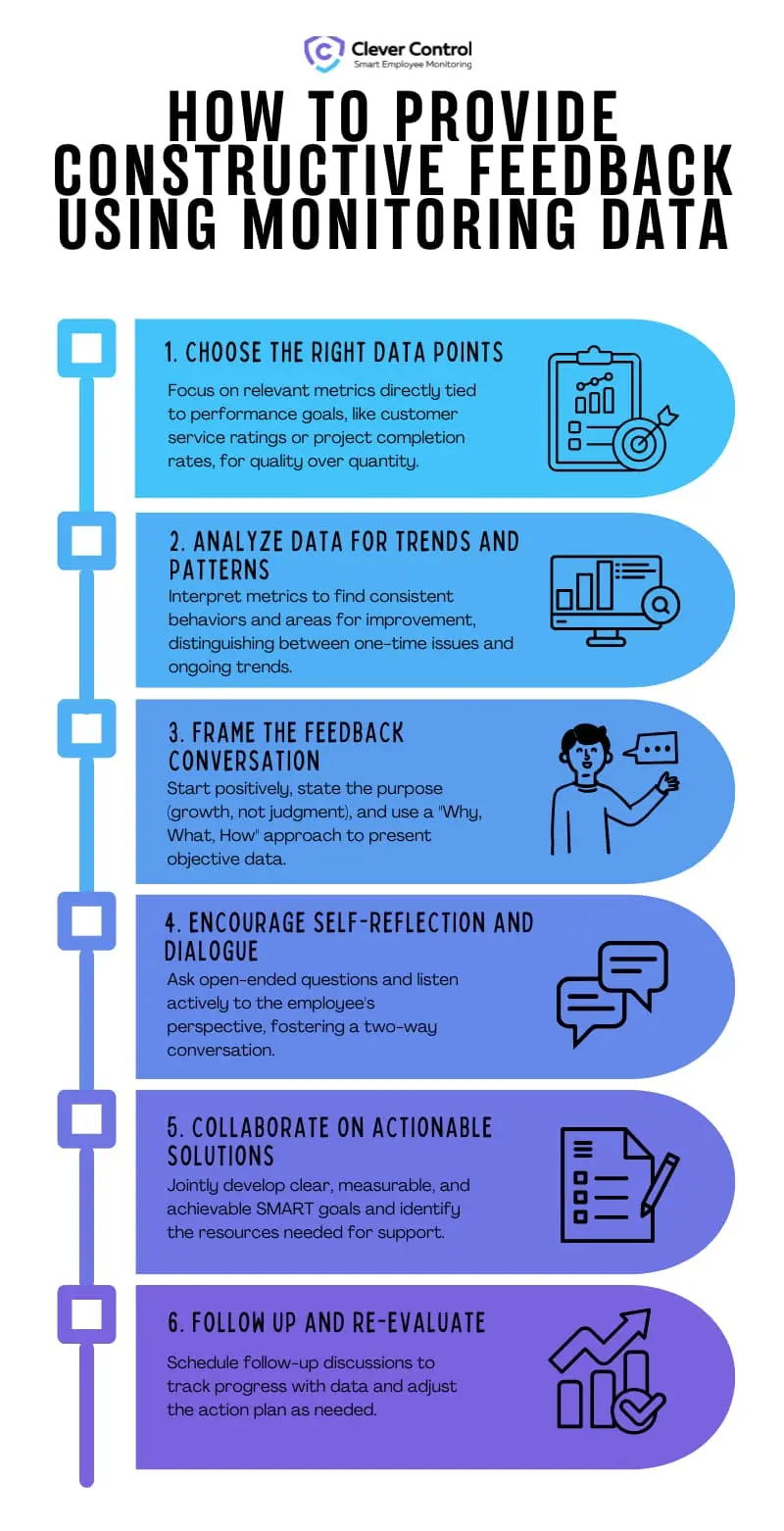
Tipp 1. Wählen Sie die richtigen Datenpunkte
Tipp 2. Analysieren Sie die Daten auf Trends und Muster
A spreadsheet with metrics alone does not bring much benefit. What does is its careful interpretation and discovery of trends and patterns. Has this metric always been low, or is it a one-off dip? Does this employee continuously struggle with a particular type of task? Does their focus always fluctuate at a certain time of the day? When you notice these patterns, you will be able to distinguish between one-time incidents and ongoing problems. Remember to consider the context too that may have influenced the employees' productivity, for example, an increased demand or technical problems.
Tipp 3. Rahmen Sie das Feedback-Gespräch
Approaching a feedback conversation with data requires a thoughtful touch. Always start with a positive. Acknowledge areas where the data shows strong performance or improvement. This sets a collaborative tone. Then, clearly state the purpose of the discussion: it's about growth and development, not judgment.
Konstruktives Feedback bedeutet, objektiv zu sein und sich auf das Verhalten und nicht auf die Persönlichkeit zu konzentrieren. Anstatt zu sagen: "Sie versäumen ständig Fristen", sagen Sie lieber: "Die Berichte zeigen, dass die Aufgaben in diesem Quartal immer wieder verschoben wurden."
Erwägen Sie einen "Warum, Was, Wie"-Ansatz:
- Warum sind diese Daten wichtig? (Zusammenhang mit Teamzielen, Auswirkungen auf Kunden usw.)
- Was zeigen die Daten im Einzelnen? (Stellen Sie die Kennzahlen und die beobachteten Trends dar.)
- Wie können wir diese Erkenntnis in Zukunft verbessern oder nutzen? (Dies ebnet den Weg für eine kollaborative Problemlösung.)
Tipp 4. Fördern Sie Selbstreflexion und Dialog
Constructive feedback is a two-way street. When you have given your evaluation, give the employee a word to explain their vision of the situation. You may prompt them by asking open questions, such as "What are your thoughts on your results?" or "What do you think might have contributed to that dip in performance?" They will encourage the employee to reflect on their work and share problems they may be experiencing. Often, they'll have valuable context you might not be aware of, or even suggest solutions themselves. Listen actively and take notes of their insights.
Tipp 5: Arbeiten Sie gemeinsam an umsetzbaren Lösungen
Konstruktives Feedback ist nur der erste Schritt auf dem Weg zur Verbesserung. Der nächste Schritt besteht darin, einen Aktionsplan zu entwickeln. Sie können ein SMART-Zielsystem (Specific, Measurable, Achievable, Relevant, Time-bound) oder ein anderes System verwenden, aber die von Ihnen gesetzten Ziele sollten messbar, klar und erreichbar sein. "Verbessern Sie Ihre Produktivität" klingt vage und wirft Fragen auf wie "Was gilt als Verbesserung?", "Was muss ich tun, um mich zu verbessern?", "Wann soll ich die Ergebnisse vorweisen?" usw. Wenn Sie jedoch mit dem Mitarbeiter vereinbaren: "Ich werde mich bemühen, die durchschnittliche Zeit für die Erledigung meiner Aufgaben im nächsten Monat um 15 % zu verringern, indem ich das neue Projektmanagement-Tool einsetze", dann weiß der Mitarbeiter genau, was er anstreben muss. Geben Sie an, welche Ressourcen, Schulungen oder Unterstützung er von Ihnen oder dem Unternehmen benötigt, um diese Ziele zu erreichen. Bei einem solchen kooperativen Ansatz wird der Mitarbeiter Sie eher als unterstützenden Partner denn als strengen Vorgesetzten sehen, was sogar seine Arbeitsmoral steigern kann!
Tipp 6. Nachfassen und neu bewerten
Feedback is an ongoing process, not a one-time event. Use the employee monitoring tool to track the person's progress and, after some time, schedule follow-up discussions to check in on progress and re-examine the monitoring data. Seeing improvements is an incredible motivation for employees! But if the progress is minimal or too slow, it is a sign to adjust and enhance the action plan.
Aufbau einer Kultur des Wachstums
Building constructive feedback based on monitoring data not only enriches individual performance reviews with objective information and makes the manager's work easier. It also helps create a transparent and strong growth-oriented culture. Feedback grounded in objective information makes employees take ownership of their work and development. It moves away from subjective critiques and towards a shared understanding of performance and potential.