
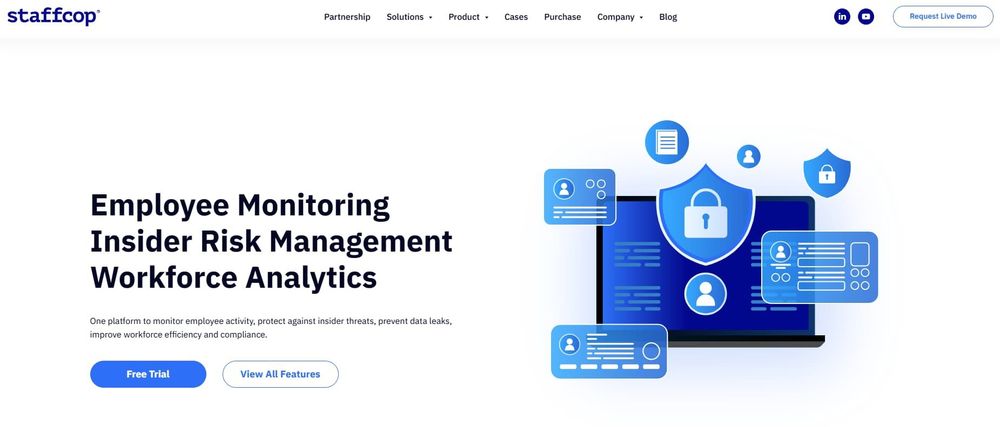
Another player in the employee monitoring software market is Staffcop. Its capabilities go far beyond employee monitoring. It offers potential users DLP features as well as insider risk management. The CleverControl team explores Staffcop's features, pros and cons, pricing, and common use cases in detail.
What Is Staffcop?
Staffcop is an employee monitoring solution that goes beyond basic activity tracking. Along with monitoring user activity across websites, applications, files, and devices, it also offers data loss prevention, insider risk detection, user behavior analytics, and compliance-focused controls. In other words, Staffcop is positioned not just as a productivity PC monitoring tool, but as a broader platform for visibility, data protection, and internal risk management.
Distinctive features at a glance:
file and device control
DLP functionality
insider risk detection
policy-based alerts and reports
Staffcop Pros and Cons
Staffcop stands out from many basic employee monitoring tools by combining activity tracking with DLP and insider risk features. This gives the platform a broader role, but also makes it more security-oriented than some businesses may need.
Pros
Combines employee monitoring with DLP and insider risk capabilities
Provides detailed visibility into user activity
Includes alerts, reports, and policy-based controls
Better suited for security-focused environments than basic monitoring tools
Cons
May be too advanced for simple monitoring needs
Can feel more security-focused than some teams require
May raise privacy concerns if implemented without clear policies
Likely requires a more thoughtful rollout than lightweight tools
Who Is Staffcop Best For?
Staffcop is better suited to businesses that need more than basic employee monitoring. Its feature set makes it more relevant for organizations that want not only visibility into employee activity, but also stronger data protection, insider risk detection, and policy-based control. This means the platform is likely to be a better fit for certain industries and business sizes than for others.
By Industry
Financial organizations often work with highly sensitive client, transaction, and internal business data. For them, Staffcop may be useful not only for employee monitoring, but also for reducing insider risk and supporting data loss prevention efforts.
Healthcare providers and related organizations handle sensitive medical and personal information, which makes internal visibility especially important. In this environment, Staffcop may appeal to businesses that want to combine user activity monitoring with stronger data protection controls.
Law firms and legal departments regularly deal with confidential documents, case materials, and client communications. Staffcop may be a relevant option for organizations that need to monitor access to sensitive information and respond to potentially risky user behavior.
Tech businesses often work with source code, product documentation, intellectual property, and internal development data. For these organizations, Staffcop may be valuable as a tool for both employee monitoring and stronger oversight of data-related risks.
Public sector environments often have stricter internal controls and higher expectations around information handling. In such cases, Staffcop may be better suited to organizations that need broader monitoring, reporting, and internal security visibility.
Even outside highly regulated sectors, Staffcop may be useful for companies that store valuable internal documents, financial records, client data, or other sensitive information. For these businesses, the platform's broader mix of monitoring and protection features may be more relevant than a basic tracking tool.
By Business Size
Mid-sized companies may benefit from Staffcop when simple activity tracking is no longer enough, but the organization still needs a manageable way to improve internal visibility. In this context, the platform may serve as a step toward more structured monitoring and data protection.
Larger organizations usually have more employees, more endpoints, and more complex internal processes. For them, Staffcop may be a better fit because its broader feature set can support monitoring, incident review, and internal control across a wider operational environment.
Businesses with remote or hybrid employees may also find Staffcop relevant, especially when visibility across distributed devices and user activity becomes harder to maintain. In these cases, the platform may help combine workforce monitoring with stronger oversight of files, applications, and web activity.
Overall, Staffcop is best suited to organizations that want a more security-oriented platform rather than a lightweight employee monitoring tool. For companies that need broader oversight, data protection, and insider risk visibility, it may be a more natural fit.
Final Verdict: Is Staffcop a Good Fit for Your Business?
Staffcop is more than a basic employee monitoring tool. Its feature set combines user activity monitoring with data loss prevention and insider risk management, which makes it a broader and more security-oriented solution than many standard products in this category.
This makes Staffcop a better fit for businesses that need stronger visibility into employee activity, sensitive data handling, and internal risk. It may be especially relevant for mid-sized and larger organizations, as well as for companies operating in industries where compliance, security, and data protection play an important role.
At the same time, Staffcop may not be the most natural choice for every business. Companies looking for a lightweight tool focused only on simple employee monitoring may find its broader scope more advanced than necessary.
Overall, Staffcop is a reasonable option for organizations that want to combine employee monitoring with stronger control over data-related risks. For businesses that need a more security-focused platform rather than a basic monitoring solution, it may be a good fit.