

Data collected by employee monitoring tools is typically perceived as a quantitative measure of an employee's efforts for spreadsheets and quarterly reports. X completed tasks, Y missed deadlines, and Z% productivity on average. However, monitoring data can be valuable material for providing constructive, actionable feedback. Want to know how? We have prepared some practical tips.
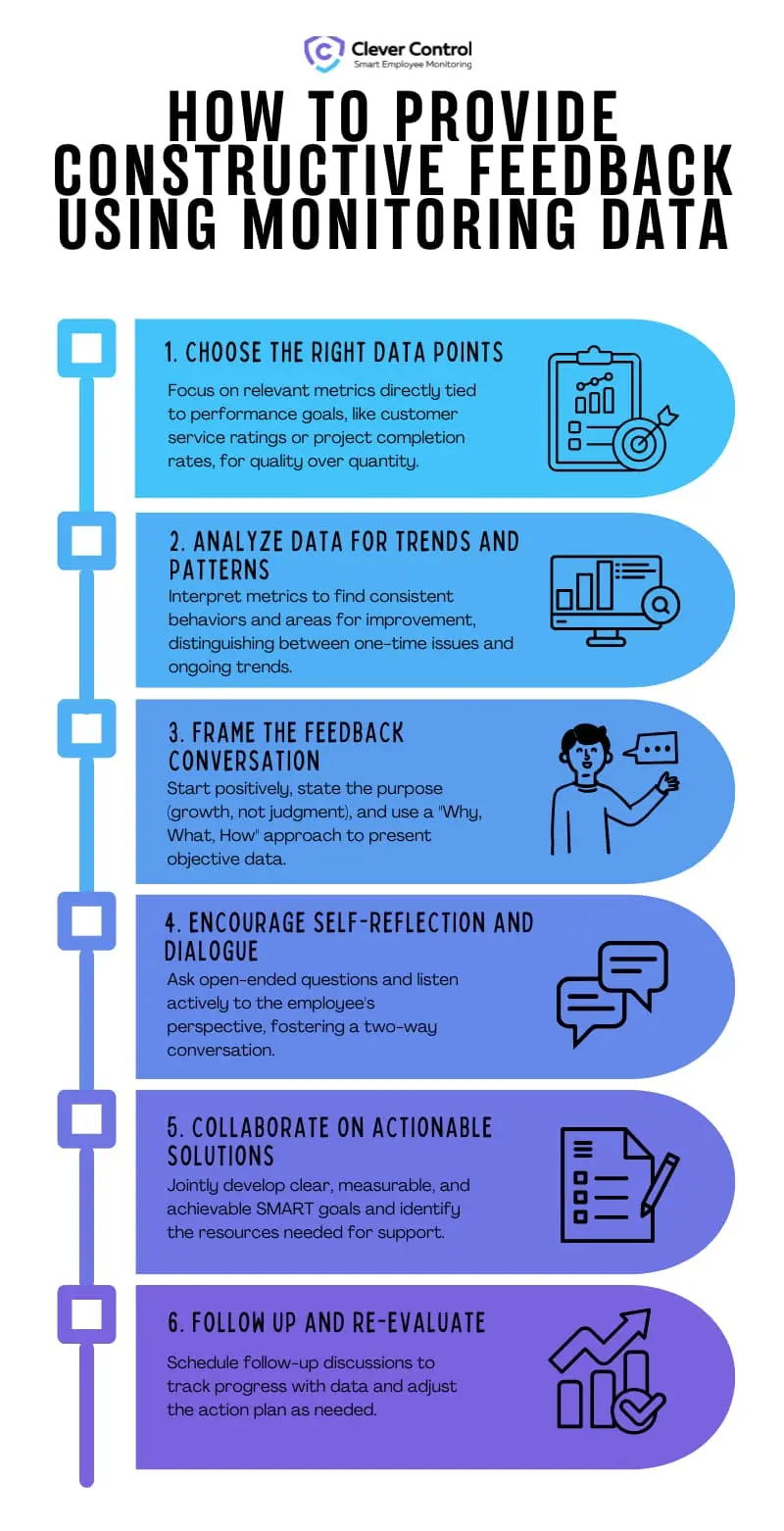
Conseil 1. Choisir les bons points de données
Conseil n° 2. Analyser les données pour y déceler des tendances et des schémas
A spreadsheet with metrics alone does not bring much benefit. What does is its careful interpretation and discovery of trends and patterns. Has this metric always been low, or is it a one-off dip? Does this employee continuously struggle with a particular type of task? Does their focus always fluctuate at a certain time of the day? When you notice these patterns, you will be able to distinguish between one-time incidents and ongoing problems. Remember to consider the context too that may have influenced the employees' productivity, for example, an increased demand or technical problems.
Troisième conseil. Encadrer la conversation sur le retour d'information
Approaching a feedback conversation with data requires a thoughtful touch. Always start with a positive. Acknowledge areas where the data shows strong performance or improvement. This sets a collaborative tone. Then, clearly state the purpose of the discussion: it's about growth and development, not judgment.
Un feedback constructif consiste à être objectif et à se concentrer sur le comportement plutôt que sur la personnalité. Au lieu de dire "Vous manquez toujours les délais", essayez plutôt "Les rapports montrent que les tâches ont été constamment retardées ce trimestre".
Envisagez une approche "Pourquoi, Quoi, Comment" :
- Pourquoi ces données sont-elles importantes (les relier aux objectifs de l'équipe, à l'impact sur les clients, etc.)
- Qu'est-ce que les données révèlent spécifiquement ? (Présenter les mesures et les tendances observées).
- Comment pouvons-nous améliorer ou exploiter cette idée pour aller de l'avant ? (Cela ouvre la voie à une résolution collaborative des problèmes).
Conseil n° 4. Encourager l'autoréflexion et le dialogue
Constructive feedback is a two-way street. When you have given your evaluation, give the employee a word to explain their vision of the situation. You may prompt them by asking open questions, such as "What are your thoughts on your results?" or "What do you think might have contributed to that dip in performance?" They will encourage the employee to reflect on their work and share problems they may be experiencing. Often, they'll have valuable context you might not be aware of, or even suggest solutions themselves. Listen actively and take notes of their insights.
Conseil n° 5 : collaborer à des solutions concrètes
Le retour d'information constructif n'est que la première étape sur la voie de l'amélioration. La prochaine étape consiste à élaborer un plan d'action. Vous pouvez utiliser un système d'objectifs SMART (spécifiques, mesurables, réalisables, pertinents et limités dans le temps) ou tout autre système, mais les objectifs que vous fixez doivent être mesurables, clairs et réalisables. "Améliorer votre productivité" semble vague et soulève des questions telles que "Qu'est-ce qui est considéré comme une amélioration ?", "Que dois-je faire pour m'améliorer ?", "Quand suis-je censé montrer les résultats ?", etc. En revanche, si vous vous mettez d'accord avec l'employé sur la phrase suivante : "Je m'efforcerai de réduire mon temps moyen d'exécution des tâches de 15 % au cours du prochain mois en utilisant le nouvel outil de gestion de projet", l'employé saura exactement ce qu'il doit viser. Identifiez les ressources, la formation ou le soutien dont il pourrait avoir besoin de votre part ou de celle de l'organisation pour atteindre ces objectifs. Avec une telle approche collaborative, l'employé vous considérera comme un partenaire qui le soutient plutôt que comme un superviseur strict, ce qui pourrait même améliorer son moral !
Sixième conseil. Suivi et réévaluation
Feedback is an ongoing process, not a one-time event. Use the employee monitoring tool to track the person's progress and, after some time, schedule follow-up discussions to check in on progress and re-examine the monitoring data. Seeing improvements is an incredible motivation for employees! But if the progress is minimal or too slow, it is a sign to adjust and enhance the action plan.
Construire une culture de la croissance
Building constructive feedback based on monitoring data not only enriches individual performance reviews with objective information and makes the manager's work easier. It also helps create a transparent and strong growth-oriented culture. Feedback grounded in objective information makes employees take ownership of their work and development. It moves away from subjective critiques and towards a shared understanding of performance and potential.