

Is there a way to gain clearer insights, offer targeted support, and enhance onboarding for every new talent? The answer to this question is employee monitoring. Tracking data is a valuable source of information about the new hire\'s potential problems in the new workplace, their knowledge gaps, and the support they may need.
Challenges in Traditional Onboarding
Traditional onboarding practices, although well-intended, often fall short of their mark. They lack real-time feedback and ways to see a new hire\'s struggles. Does the person truly understand how to use the unknown software? Are they comfortable asking questions, or do they keep their confusion to themselves? Identifying these struggles becomes a reactive, rather than proactive, practice without a clear window into their daily experiences.
Lack of understanding of the new hire\'s experiences leads to inconsistent and ineffective training and support. A standardized approach does not account for individual learning styles and current knowledge and experience. What works for one may not work for another. Besides, with standard practices, it is challenging to identify and address individual knowledge gaps before they impact productivity.
The result? New talents can feel unsupported, confused, and overwhelmed. When onboarding fails to provide adequate support and a clear path to success, even the most promising talent can quickly disengage and look for opportunities elsewhere.
Understanding Employee Monitoring
What do we imagine when we hear the phrase "employee monitoring"? Most probably, some intrusive spy that immediately alerts the manager if you stop working for one minute. However, this picture is exaggerated, outdated, and far from modern ethical monitoring practices.
In its modern application, particularly regarding talent development and support, employee monitoring refers to gathering data on work-related activities, software usage, and communication patterns. The distinction is in the purpose: employee monitoring is no more about punitive oversight. It has become a tool for tracking work patterns, their analysis, finding learning opportunities, and proactive support.
Monitoring can provide valuable insights that can significantly enhance onboarding. First, performance metrics, such as progress on assigned tasks, task completion rates, and adherence to established workflows clearly indicate the new hire\'s knowledge, skills, and efficiency.
Monitoring the new employee\'s participation in team communication and the type of questions they ask indicates how comfortable they are asking for assistance and how their integration into the team goes.
Finally, seeing how much time the new hire spends on training resources or particular job functions may hint at where they experience difficulties. Or it may be a sign that the training itself is inefficient and could be optimized.
Traditional onboarding strategies are often based on assumptions, subjective observations, and universal approaches. Onboarding strategies powered by ethical employee monitoring are based on concrete, actionable information and, consequently, more effective.
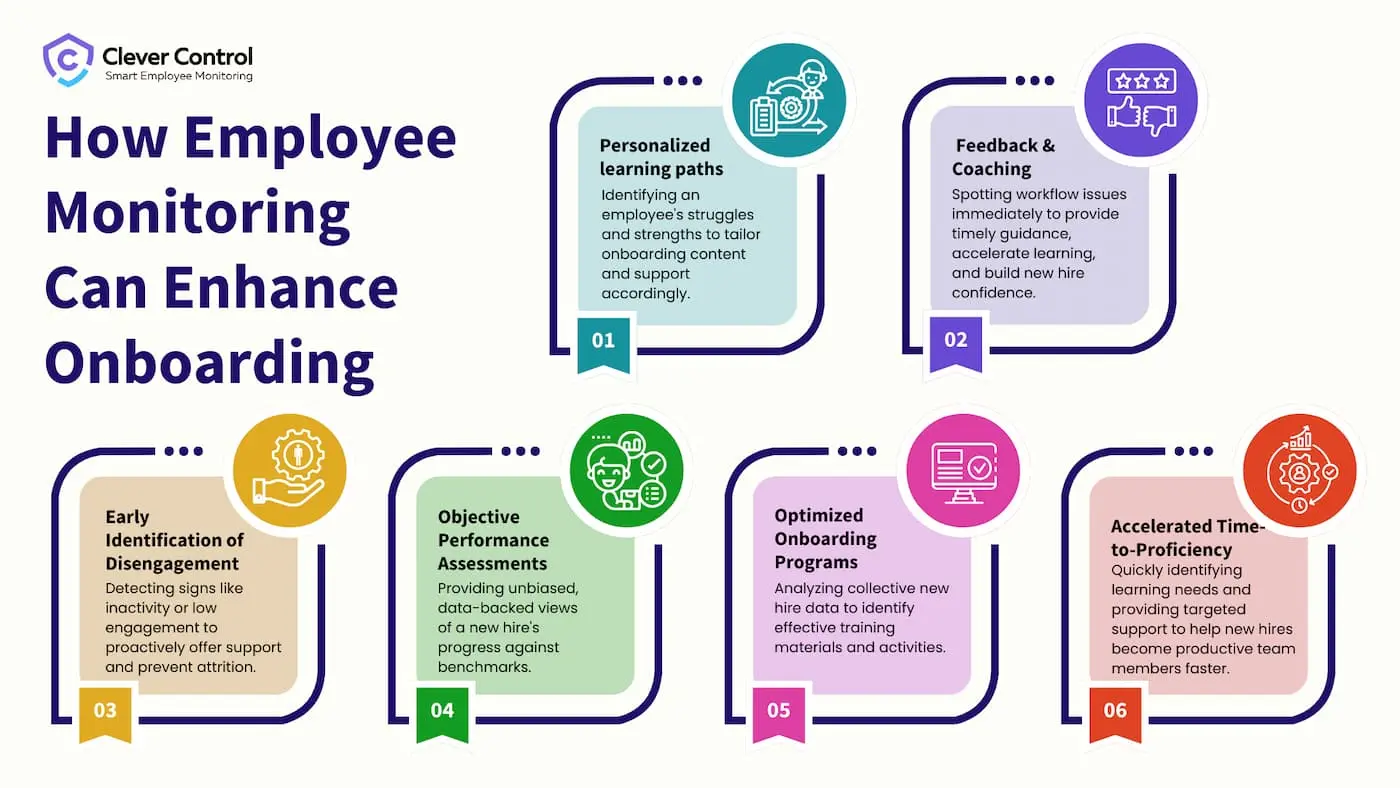
How Employee Monitoring Can Enhance Onboarding
So, as we can see, employee monitoring gives managers a clear view of the new hire\'s first steps in the company and allows them to notice issues before they escalate. Here is how it can enhance the onboarding process.