
How to Inform Employees About Monitoring: Best Practices

Your company has invested in employee monitoring software. It tracks employee attendance and productivity, flags security problems, and carefully logs every website each employee visits. Using monitoring is a smart and legitimate step: productivity metrics help everyone stay on track and accountable. Besides, information is one of the most valuable resources today, and the risks of data leaks and security threats are higher than ever. But do your employees know they are under surveillance?
At first glance, secret monitoring seems to deliver more honest results. When employees do not know about tracking, they behave as usual. They may be late, spend half of the workday on shopping sites, or take a two-hour lunch break. In reality, however, secret monitoring is a minefield. It may spark legal trouble, ruin trust, and turn your workplace into a pressure cooker of suspicion.
The truth is, how you inform employees about monitoring matters as much as the monitoring itself.
Why Transparency Is the Best Policy
Most employees assume their work devices are not entirely private. But assumption is not consent. And when monitoring surfaces unexpectedly - say, in a performance review or disciplinary meeting - employees feel blindsided. Distrust follows. Resentment grows.
Above that, secret monitoring is illegal in many jurisdictions. GDPR in Europe, laws in several U.S. states, such as Connecticut, New York, and California, PIPEDA in Canada, the Workplace Surveillance Act 2005 in Australia, the LGPD in Brazil, and other regulations across the world require employers to notify employees about surveillance. Failing to comply with them can result in fines, lawsuits, and a damaged public image of the company.
The last - but not the least - is the culture. A workforce that feels watched without explanation becomes disengaged and may even quietly look for the exit. Surveys prove it: intrusive employee monitoring software would be a reason to quit their job for 63% employees. Transparency, on the other hand, fosters accountability. When people know why monitoring exists, they are more likely to respect the boundaries and the purpose.
Studying the Legal Environment
When considering employee monitoring, the number one best practice is understanding the legal environment. There is no universal recipe; regulations vary significantly depending on the country or even the area. Some monitoring methods, such as call recording or webcam surveillance, may be prohibited in your area, while others, such as email monitoring, may require explicit employee consent in written form.
The industry may influence your monitoring practices, too. Some industries, for example, finance and healthcare, require stricter control measures than others.
Bottom line? We recommend studying your industry requirements, consulting a legal expert in your area, and tailoring your monitoring practices to the recommendations. A one-size-fits-all template might look convenient, but it will not protect you against potential lawsuits.
How to Inform Employees about Monitoring: Best Practices
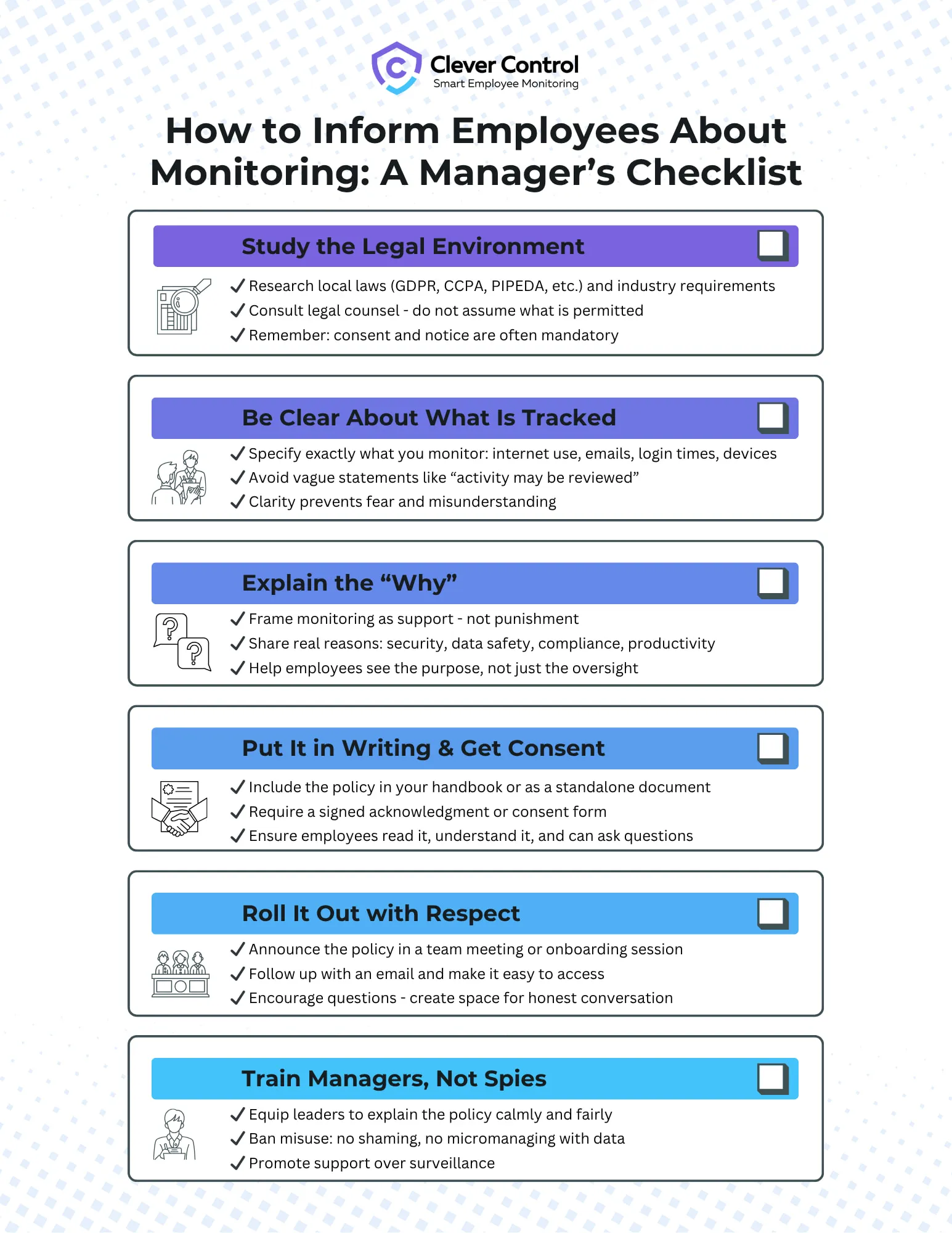
1. Be Clear
Avoid vague phrases like "system activity may be reviewed." Instead, explain directly what you are doing:
"We monitor internet usage on company devices to prevent malware and ensure network security."
"Emails sent through company accounts are subject to review for compliance with industry regulations."
Clarity reduces anxiety and stress usually associated with monitoring.
2. Explain the "Why"
People accept rules they understand. So, the best practice here is not just to announce monitoring, but to contextualize it.
You may say:
"We monitor remote workstations to detect unauthorized access, because last year, a phishing attack nearly compromised client data."
Or: "We track system uptime to identify bottlenecks that slow your work."
When monitoring is framed as protection or improvement, not suspicion, it has a different effect.
3. Put It in Writing And Make It Accessible
Your monitoring policy belongs in the employee handbook. Or, if it is detailed, as a standalone document. Either way, it should cover:
- What is monitored (e.g., login times, file access, webcam use)
- Why it is monitored (security, compliance, productivity)
- How long data is stored
- Who can access it (e.g., IT, HR, department heads)
- Employee rights (e.g., to request their data)
Keep the tone professional but approachable.
4. Rolling Out
Announce the policy in person. Host a brief team meeting. Send a follow-up email with the document attached. Make it easy to find on your intranet.
Concerns are expected and normal here. Some employees will worry about micromanagement. Others may fear being judged for a five-minute social media scroll. Address these head-on.
You may even create an FAQ with employees' most common questions, for example:
- "Can you read my private messages?" Only if they are on company systems - and only if policy allows.
- "Are my personal files monitored?" Not unless stored on company devices.
- "How long is data kept?" Typically 90-180 days, unless needed for investigation.
Invite feedback. Anonymous surveys work well. You might learn that employees appreciate knowing systems are secure, even if they are being watched.
5. Get Informed Consent
A signature is not just paperwork. It is proof that employees understand what they agree to.
You can use a simple consent form, such as the sample below. Employees should sign it during onboarding or when the policy is introduced. If someone feels pressured, that is a red flag - not just ethically, but legally.
Sample Consent to Monitoring Document
Here is a template you can adapt (we recommend consulting with your legal expert):
Employee Monitoring Consent Agreement
I, [Employee Name], acknowledge that [Company Name] may monitor, log, and review my use of company-provided devices, networks, email, internet access, and software applications. This includes, but is not limited to, websites visited, files accessed, and application usage.
This monitoring is conducted to ensure data security, prevent misuse of resources, comply with legal requirements, and maintain a productive work environment.
I understand that my activity on company systems may be reviewed at any time. Personal use of these systems should be minimal and in line with company policy.
I have read the Employee Monitoring Policy and had the opportunity to ask questions. I consent to this monitoring as part of my employment.
Signature: _________________________
Printed Name: ______________________
Date: ___________
6. Train Your Leaders
Managers are the front line. If they cannot inform employees and explain the policy calmly - or worse, misuse the data - it could be a problem.
Train supervisors on:
- How to answer employee questions without defensiveness
- What they can and cannot do with monitoring data
- How to avoid creating a culture of surveillance
A manager who says, "I saw you were on YouTube for 20 minutes," without context, damages morale. One who says, "I noticed some off-task browsing - everything okay?" opens a dialogue.
7. Respect the Line Between Work and Personal
Even on company devices, employees have a right to some privacy. The best practice is to avoid monitoring personal emails, private chats, or non-work apps unless there is a clear policy and consent.
And never record audio or video in private areas. Cameras in break rooms or restrooms are not just unethical; they are illegal.
Final Thoughts
Informing employees about monitoring is not just a legal obligation - it is a necessity for maintaining trust. When done right, it turns a sensitive topic into a moment of clarity and mutual respect.
Security risks are real. Productivity needs measurement. And some form of employee monitoring is necessary. But necessity does not replace the need for transparency. The best practices for employee monitoring can be summarized in one phrase: treating people fairly.
Be clear. Be honest. Be consistent. Explain the why, get real consent, and respect personal boundaries. Train your managers not to police, but to support. Your team is not under suspicion; they are part of the solution.
Done with integrity, monitoring does not erode trust - it strengthens it.