
What Are the Ethical Boundaries of Employee Surveillance?

Employee monitoring has become a common practice today. When companies consider tracking employees, they evaluate the benefits, select activities to monitor, tools to implement for that, and study state and local laws that regulate employee monitoring in the area. What managers often dismiss is the ethical side of tracking. However, this dismissal can be devastating for the psychological climate in the team and the company culture.
In this article, we will explore the ethical boundaries of employee surveillance: the negative effects of excessive tracking, and the ethical principles of monitoring.
The "Why": Legitimate Business Reasons for Monitoring
Employee surveillance is often a necessity in regulated areas, such as finance or healthcare, and highly beneficial in other industries. Companies that use it usually pursue the following goals:
Performance evaluation;
Finding inefficiencies and improving the work processes
Preventing data leaks and increasing security;
Compliance with industry-specific regulations;
Remote team management.
These goals are legitimate, but they do not negate the need for ethical usage of monitoring.
The Ethical Core of Employee Surveillance
At the core of the ethical debates around employee surveillance is the ultimate question: how much oversight is appropriate without undermining trust and dignity?
Employees act as their professional selves at work, but they still expect a reasonable amount of privacy. Constant monitoring, especially when invisible or overly intrusive, can make people feel distrusted, watched, or even dehumanized. As a result:
Employees feel more stressed and anxious. A survey conducted by ExpressVPN showed that 56% of monitored employees feel stress and anxiety due to surveillance.
The American Psychological Association's 2023 survey confirms the negative impact of employee monitoring: 45% of monitored respondents say their workplace has a negative impact on their mental health, compared to 29% of non-monitored employees.
Employees feel their privacy is violated. According to ExpressVPN's survey, 48% of employees would even be willing to reduce their pay if it means no surveillance.
Employees lose trust and commitment to their company. Tara Behrend, PhD, John Richard Butler II professor of human resources and labor relations at Michigan State University, says: "When monitoring is used as an invasive way of micromanaging, it violates the unspoken agreement of mutual respect between a worker and their employer. A person will be much less likely to go above and beyond to help the organization if that trust is broken. They basically retreat into doing the bare minimum."
Employees become less creative and innovative. A culture of constant scrutiny may discourage risk-taking and creative thinking - qualities essential for long-term growth.
Employees are more likely to engage in undesirable behaviors. Taking unapproved breaks, stealing office equipment, and working slowly on purpose become the norm when employees lose agency.
Moreover, there is a risk of bias in how monitoring data is interpreted. Without proper rules and policies, subjective judgments or incomplete data could lead to unfair evaluations or discriminatory practices. That is why establishing ethical boundaries around surveillance practices is crucial.
Establishing Ethical Boundaries: Practical Tips
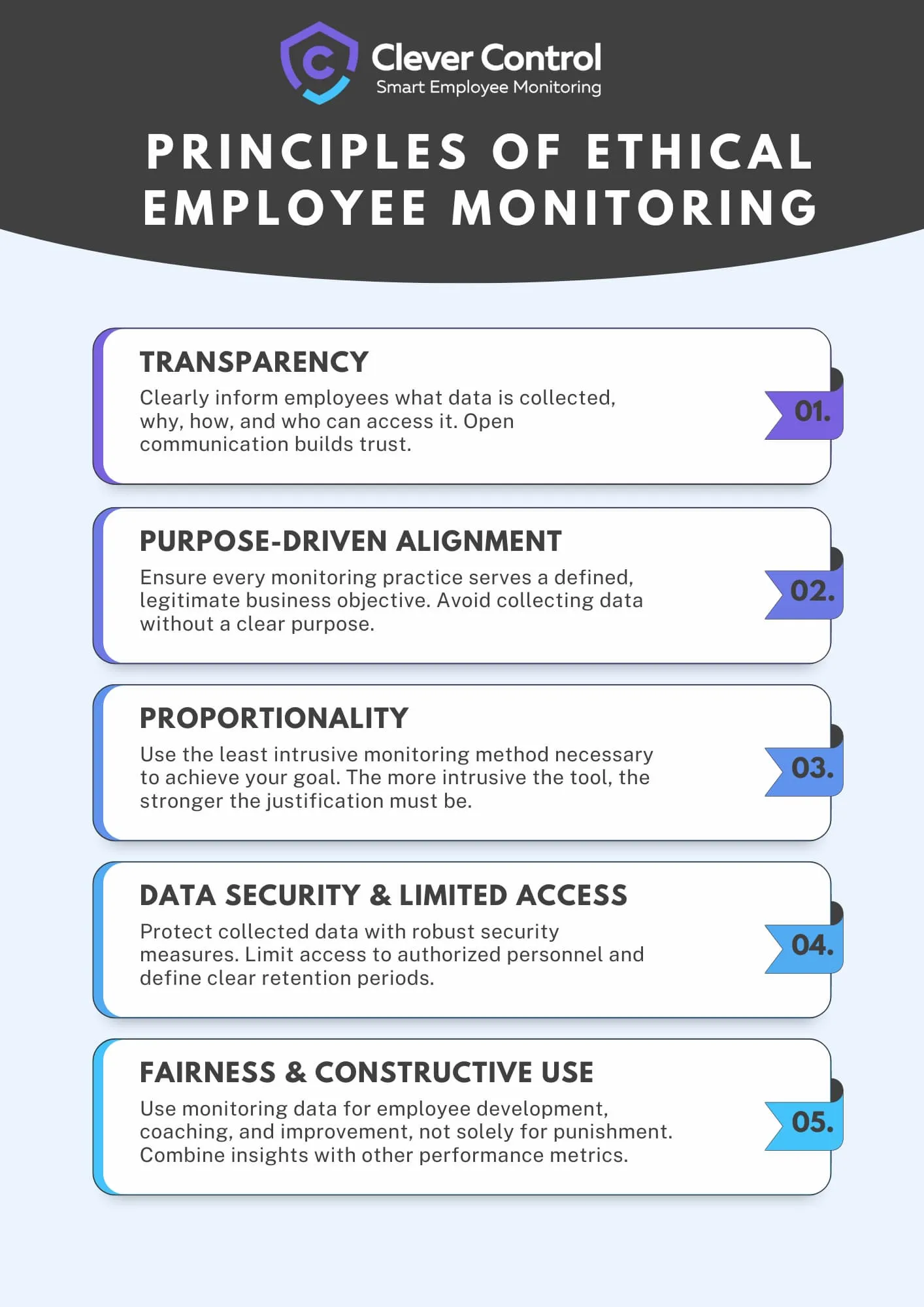
To avoid the negative effects of monitoring on employees, companies should consider the following principles:
1. Transparency
Even if regulations in the area do not specifically require informing employees about monitoring, it is always best to do it. It fosters mutual respect and improves the perception of surveillance. Employees should know:
What data is being collected (e.g., login times, application usage, email metadata).
Why it’s being collected (e.g., security, compliance, performance).
How long it will be retained, and who can access it.
You can include these details in employee contracts, handbooks, internal policies, and onboarding materials.
2. Alignment with clear business purposes
Every monitoring practice should serve a defined, legitimate objective. Avoid “monitoring for monitoring’s sake.” For example:
Use keystroke logging only if there is a documented security risk.
Track website usage to manage productivity - not to scrutinize personal breaks.
Capturing personal communications or activities outside work violates the ethical boundaries of employee surveillance.
3. Proportionality
Choose the least intrusive method that achieves your goal. For instance:
Instead of recording screens 24/7, consider periodic activity summaries.
Replace invasive tracking with outcome-based performance metrics where possible.
The more intrusive the tool, the stronger the justification must be.
A good way to define the ethical boundaries is to involve employees in the design of monitoring policies and scope. Tara Behrend says: “Asking workers what they think is a meaningful and fair way of measuring their performance makes it more likely that the metrics will be useful, and that they will be accepted by workers when deployed.”
4. Data security and limited access
Treat the collected data as you treat the company’s sensitive information. It must be protected with strong security measures. Only authorized personnel, such as HR, IT security, or managers, should have access to monitoring data. These employees should know the principles of ethical data handling and security.
The collected data should have a set retention period. The longer you store the data, the greater the ethical and legal risks. Securely delete the information that no longer serves its purpose.
5. Fairness and constructive use of data
Monitoring should be used to support development, not punishment. Use insights to:
Identify training needs.
Recognize high performers.
Coach employees who face challenges.
Never make decisions based on the monitoring data alone. Always evaluate employee performance with a combination of monitoring logs, their contribution to the project, and the value they generate for the company. Managers interpreting surveillance data should be trained to do so objectively, avoiding assumptions or bias.
Conclusion
The decision to implement employee surveillance is not just a technological one - it is a cultural and ethical choice. When handled poorly, it can damage morale, increase turnover, and harm your employer brand. When approached with care, transparency, and respect, it can enhance security, improve performance, and reinforce a culture of accountability.
The key lies in recognizing and honoring the ethical boundaries that protect employee dignity while supporting business goals. By being transparent, purposeful, and proportionate, managers and business owners can use monitoring tools not as instruments of control, but as enablers of trust, fairness, and sustainable success.